How to add a document with an attachment via Rest API
6.2.0 and laterThe article describes how to add a new entry with an attachment in the Documents module via Rest API.
Before continuing, please research the methods and ways of communication described here: https://doc.yetiforce.com/api/
1. Create a document with an attachment
To create an entry in the Documents module use an API method the allows for record creation, i.e.

https://doc.yetiforce.com/api/#/BaseModule/ea3b9bea091cbde741323b5393901825
Creating a new record in the Documents module requires entering the following values:
-
notes_title- document name. -
folderid- directory identifier. -
filelocationtype- file type. This field specifies the attachment type. Two values are available:I- internal (attachment),E- external (link). -
filename- file or URL. Attachment or link.
Below are some examples of API query construction:
Postman
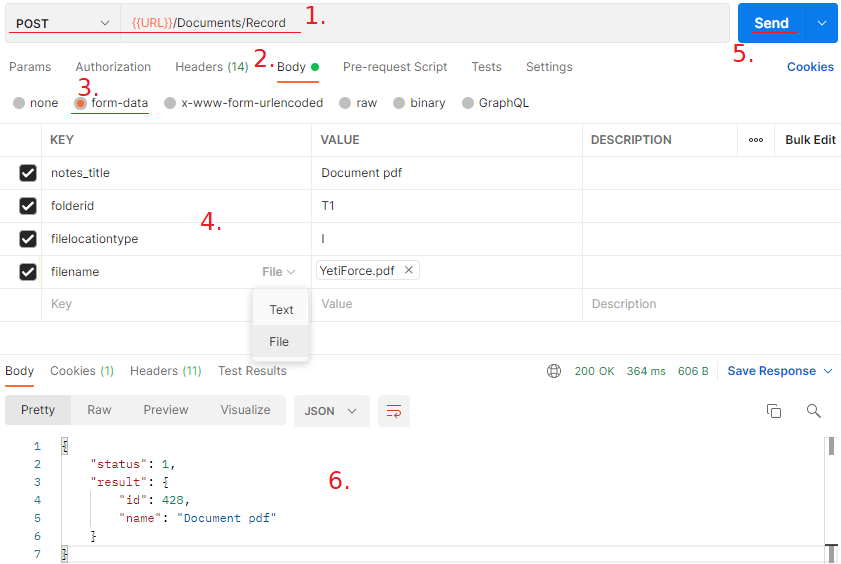
Guzzle - HTTP client for PHP
https://github.com/guzzle/guzzle
$uri = 'https://example.com/webservice/RestApi/Documents/Record';
$options = [
   'headers' => [
     'User-Agent' => 'YetiForceRestApi',
     'x-api-key' => 'P0fzRUuzPNWC9pxYq3MeEUp6AJ9EJpWN',
     'x-token' => '9c65f656c9380b7066d992ec59c00c0d29147a579351742b0e9f43a73312f5be',
   ],
  'auth' => ['userName', 'Password'],
  'timeout' => 10,
  'connect_timeout' => 2
];
$httpClient = new \GuzzleHttp\Client($options);
$options['multipart'] = [
   ['name' => 'notes_title', 'contents' => 'Document pdf'],
   ['name' => 'filelocationtype', 'contents' => 'I'],
   [
     'name' => 'filename',
     'filename' => 'YetiForce.pdf',
     'contents' => file_get_contents('YetiForce.pdf')
   ]
];

$response = $httpClient->request('POST', $uri, $options)->getBody()->getContents();
cURL - PHP
$url = 'https://example.com/webservice/RestApi/Documents/Record';
$headers = [
   'User-Agent: YetiForceRestApi',
   'x-api-key: P0fzRUuzPNWC9pxYq3MeEUp6AJ9EJpWN',
   'x-token: 9c65f656c9380b7066d992ec59c00c0d29147a579351742b0e9f43a73312f5be',
   'Content-Type: multipart/form-data'
];
$userName = 'userName';
$password = 'Password';

$cf = new CURLFile(realpath('YetiForce.pdf'));
$ch = curl_init();
curl_setopt($ch, CURLOPT_URL, $url);
curl_setopt($ch, CURLOPT_HTTPHEADER, $headers);
curl_setopt($ch, CURLOPT_HTTPAUTH, CURLAUTH_ANY);
curl_setopt($ch, CURLOPT_USERPWD, "{$userName}:{$password}");
curl_setopt($ch, CURLOPT_RETURNTRANSFER, true);
curl_setopt($ch, CURLOPT_POST, true);
curl_setopt($ch, CURLOPT_POSTFIELDS, ['notes_title' => 'Document pdf', 'filelocationtype' => 'I', 'filename' => $cf]);

$response = curl_exec($ch);
2. Relating a document to another entry
To link the created document to another record in the system, add the following to the API query from point 1:
-
relationOperation(bool) - by setting the valuetrue, we specify that the entry that is being created is subject to connection in a relation. -
sourceModule(string) - name of the module with which the created document should be associated. -
sourceRecord(int) - the record identifier with which the created document should be associated. -
relationId(int) - optional, identifier of the relationship between modules. Complete if there is more than one relationship between modules.
Example query structure with relational binding:
$httpClient = new \GuzzleHttp\Client($options);
$options['multipart'] = [
 ['name' => 'notes_title', 'contents' => 'Document pdf'],
 ['name' => 'filelocationtype', 'contents' => 'I'],
 [
     'name' => 'filename',
     'filename' => 'YetiForce.pdf',
     'contents' => file_get_contents('YetiForce.pdf')
 ],
 ['name' => 'relationOperation', 'contents' => true],
 ['name' => 'sourceModule', 'contents' => 'Contacts'],
 ['name' => 'sourceRecord', 'contents' => 124]
];
$response = $httpClient->request('POST', $uri, $options)->getBody()->getContents();